

The Puerta de Hierro – Segovia de Arana Health Research Institute signed and sent the commitment statement to the European Commission in March 2018, endorsing the principles of the “European Charter for Researchers” and the “Code of Conduct for the Recruitment of Researchers.”
The Charter and Code of Conduct are recommendations from the EC to member states, which are invited to apply them voluntarily:
- The European Charter for Researchers is a set of general principles and requirements that define the roles, responsibilities, and rights of researchers, employers, and funders.
- The Code of Conduct for Recruitment of Researchers consists of a set of general principles and requirements to be followed by employers and/or funders when appointing or recruiting researchers. It emphasizes the importance of open, transparent recruitment processes and diverse, experienced selection committees.
The HRS4R strategy is a self-assessment and evaluation process that culminates in recognition for institutions presenting an appropriate action plan to improve their HR policies and align them with the Charter and Code. It is a tool launched by the European Commission to support universities, research institutions, and organizations funding research in applying the European Charter for Researchers and the Code of Conduct for the Recruitment of Researchers, aimed at contributing to the development of an attractive European labor market for researchers.
HR Logo
The quality label granted by the European Commission “HR Excellence in Research” identifies institutions that foster and support a stimulating and favorable environment for research work.
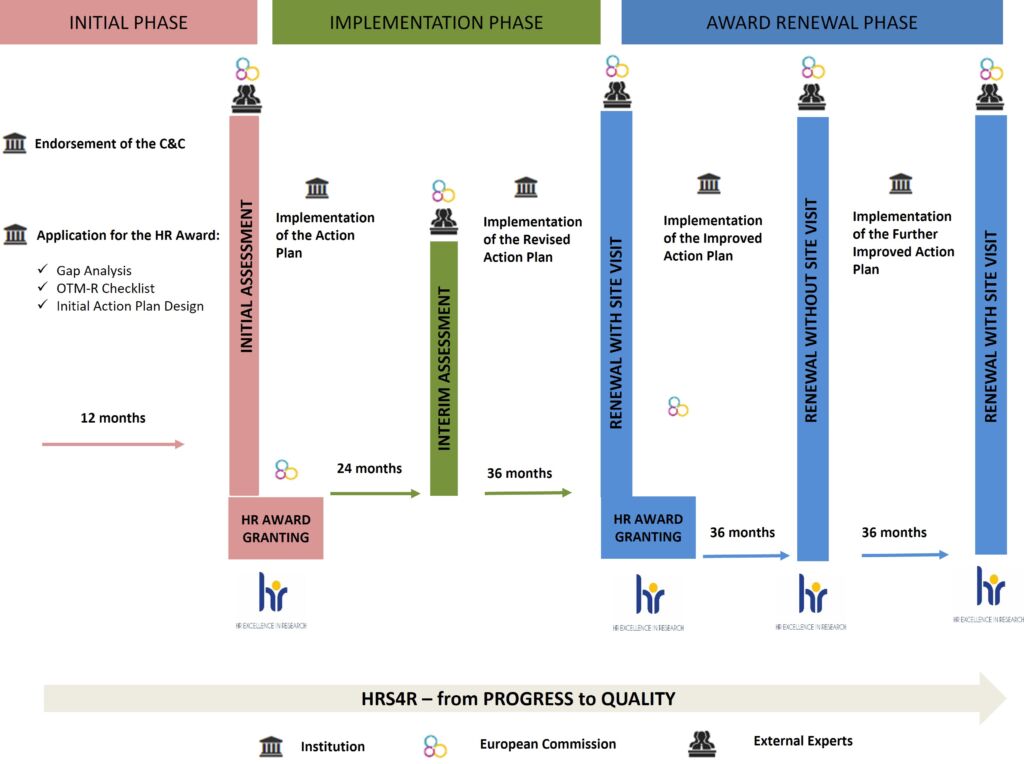
Process Stages
- The initial phase: begins with the signing of the adhesion letter and must be developed within a maximum period of 12 months. This phase involves an internal analysis of the institution’s deficiencies and weaknesses to evaluate its practices in professional ethics, researcher recruitment, working conditions, and training based on the principles established in the European Charter for Researchers and the Code of Conduct (GAP Analysis). This analysis enables a series of actions and recommendations to align human resources policies with the stated principles outlined in the Action Plan. This initial phase culminates with the granting of the HRS4R seal of excellence awarded by the European Union to institutions that define and execute an action plan to implement the Charter and Code guidelines.
- The implementation phase: in this phase, an intermediate evaluation is conducted to verify the implementation of the Action Plan by monitoring its progress through the defined indicators for each action and thematic block (ethical and professional aspects, recruitment, working conditions and social security, and training). Additionally, procedures leading to an OTM-R Policy (an acronym for “Open, Transparent, and Merit-based Recruitment”) are defined in this phase.
- The renewal phase: to access this phase, the institution must undergo an on-site evaluation by experts who will verify the degree of implementation of the HRS4R strategy and the institution’s commitment to the objectives set during the previous phases. Accessing this phase allows for the implementation of an enhanced Action Plan with the inclusion of new activities that improve the institution’s human resources policy related to research.
IDIPHISA welcomes and supports the recommendations of the European Commission contained in the ‘European Charter for Researchers’ and the ‘Code of Conduct for the Recruitment of Researchers’. It also commits, in accordance with its internal policies, to develop its human resources strategy, adhering to the recommendations and principles set out in the Charter and the Code and to ensure transparency, accessibility, equity and the pursuit of excellence in the recruitment of researchers.
IDIPHISA signed and sent to the European Commission in March 2018 the declaration of commitment to the principles of the ‘Charter for European Researchers’ and the ‘Code of Conduct for the Recruitment of Researchers’.
In April 2019, both the GAP analysis and the IDIPHISA Action Plan were sent to the European Commission for assessment. The IDIPHISA Action Plan can be downloaded from the following link:
In August 2021, the revised Action Plan was sent to the European Commission for assessment within the framework of the mid-term review following the completion of the first part of the Implementation Plan:
Specific HR initiatives in the IDIPHISA:
You can consult the status of the initiatives planned by the IDIPHISA within its HRS4R Action Plan at the following link:
Status: Completed
- Update the recruitment manual to include all OTM-R and C&C criteria.
- Improve the visibility of job offers: publish job vacancies in English on international scientific portals and on Euraxess.
- Formalise the composition of the Selection Committee, increasing diversity.
- Publish the list of recruitment outcomes together with the scores obtained by candidates who reach the interview stage.
Status: Completed
The recruitment manual/procedure has been updated and the CV submission form on the IDIPHISA website has been modified.
Define an evaluation system so that postdoctoral researchers, either at the end of their contract or on an annual basis, can obtain an official certificate describing the tasks carried out during their contract. The evaluation system should be aligned with the guidelines of the research career plan defined by the Regional Government of Madrid.
Status: Completed
In November 2024, the R2 Researcher Evaluation Guide was published, together with the corresponding evaluation form.
This tool allows R2 researchers to voluntarily request a formal evaluation of their competencies and professional development. The procedure provides a transparent framework to identify strengths, areas for improvement and training needs, supporting research career planning.
The guide includes a description of the different researcher profiles and of the competencies associated with the R2 stage, aligned with the European research career framework.
 R2 Researcher Evaluation Guide
Status: In Progress
Since 2022, more than 50 communication and awareness-raising activities related to the HRS4R strategy and researchers’ professional development have been carried out.
These activities have included training seminars, information sessions, meetings with researchers, dissemination of new policies and procedures, launch of new website sections, publication of institutional documents, and internal and external communication actions.
In addition, the IDIPHISA Communication Plan 2023-2027 and its specific HRS4R annex were approved, with the aim of increasing the visibility of initiatives addressed to researchers and promoting greater participation of the research community in institutional processes.
Status: In Progress
- IDIPHISA has a Training Plan 2023-2027, which provides a stable annual training offer.
- To identify new training needs, an annual online survey addressed to the whole research community and support staff is launched, and its results are used to update the training offer.
- In recent years, IDIPHISA has approved specific budget allocations for the organisation of in-house training courses and the reinforcement of training activities.
- Between 2023 and 2025, 172 training activities were delivered, covering scientific, transversal, research management and career development competencies.
Status: Extended
In 2024, the seminar “Research Career Development within the European Framework” was organised and delivered by Elisa García García, Project Officer at the Spanish Foundation for Science and Technology (FECYT). The session provided an overview of the main European career development models and the European Commission’s recommendations regarding research careers.
In addition, in July 2025, the new Collective Agreement for Biomedical Research Foundations of the Community of Madrid was signed, establishing a common professional development framework for all employees of the Biomedical Research Foundations.
The agreement includes a Professional Career Framework structured into four levels, defining the requirements and competencies associated with each level and providing a common framework for professional progression and performance recognition.
The progressive implementation of this model represents an important step towards consolidating a professional development strategy aligned with the principles of HRS4R.
Design a career development map describing career opportunities in research both within and outside IDIPHISA. The framework should provide information on career opportunities and funding schemes in biomedical research, covering both academic and non-academic career paths.
Status: Completed
A new section has been developed on the IDIPHISA website to provide information on career development opportunities for researchers.
Career Development Opportunities for Researchers
Additionally, a dedicated seminar was organised. The recording can be accessed through the following link:
Status: In Progress
In 2025, IDIPHISA launched the first pilot edition of its Mentoring Programme aimed at researchers in the early stages of their careers (R1 and R2).
The programme consisted of six informal meetings between mentor and mentee over a period of approximately six months, with the objective of supporting professional development, career planning and the acquisition of transferable skills.
A total of seven researchers participated in this first pilot edition, representing different research areas within the Institute:
- Five researchers from the Lung Cancer Research Area.
- One Medical Oncology Resident.
- One researcher from the Cardiology Research Area.
Following completion of the pilot programme, a satisfaction survey was conducted to identify improvement opportunities and support the design of a second edition.
As a result of the positive experience, a new edition of the Mentoring Programme was launched in 2026, consolidating this initiative as a tool to support researchers’ professional development.
This document should be understood as a collective self-regulation instrument that reinforces and complements the commitments and recommendations included in the Institute’s internal regulations.
Status: Completed
Good Scientific Practice Manual
In addition, a dedicated training session was organised. The recording can be accessed through the following link:
The handbook provides new researchers with the information required to facilitate their rapid integration into the Institute’s working environment.
Status: Completed
IDIPHISA Welcome Handbook
FIBHUPHM Employee Handbook
- Develop a catalog that includes all the scientific and technological equipment available at IDIPHISA and that may also include other scientific services available outside the institute.
- Identify and prioritize common needs for the acquisition of new equipment.
Status: In Progress
A pilot of the new Research Infrastructure Inventory Management System of IDIPHISA has been developed. This system will collect the entire catalog of IDIPHISA infrastructures and make it accessible to all its researchers. The new system can be accessed via the following URL:
Status: Completed
SiGIPHISA, a web-based application for the registration, management and consultation of IDIPHISA’s research infrastructures and scientific equipment, has been developed and implemented.
The platform centralises information on available equipment and improves its visibility and accessibility for the entire research community.
The main functionalities implemented include:
- Bulk upload of equipment through Excel templates.
- Consultation of the scientific equipment available within the Institute.
- Updating and maintenance of equipment information by laboratory managers.
- Generation of a unique QR code for each registered piece of equipment, facilitating identification and traceability.
The implementation of this tool contributes to optimising the management of research infrastructures, promoting the shared use of equipment and improving access to available scientific resources.
Create a Research Ombudsperson, either through an individual or a committee, to deal with complaints and appeals from researchers, including conflicts between supervisors and researchers in the early stages of their careers.
Status: Completed
|
Mission |
To mediate in appeals raised by researchers at any stage of their career, with the aim of improving research quality and the working environment. |
|
Responsibilities |
|
|
Composition |
|
|
Contact |
|
|
Regulations |
Research Ombudsperson Regulations |
Develop a work-life balance plan with the following objectives:
- Achieve a balance between work and family responsibilities through flexible working arrangements.
- Adapt the organisation to social changes related to family structures, social indicators, habits and lifestyles.
- Protect maternity and paternity rights, childcare and dependent care responsibilities.
- Encourage women’s access to and retention in employment.
Status: Completed
A specific Work-Life Balance Annex has been developed in order to increase the visibility of the measures already included in the Equality Plan.
Status: In Progress
The HRS4R Working Group meets regularly to monitor the implementation of the Action Plan, assess progress achieved and propose new initiatives that contribute to the fulfilment of HRS4R principles.
As part of the awareness-raising and dissemination activities, four seminars were organised in 2024:
- Seminar 1: HRS4R in Organisations: Action Plan and OTM-R Measures.
- Seminar 2: Good Scientific Practices within the HRS4R Framework.
- Seminar 3: Research Career Development within the European Framework.
- Seminar 4: Recruitment Policies and the Implications of OTM-R at IDIPHISA.
In addition, in 2025 a new survey was conducted among the research community to assess awareness and perceptions of the measures implemented under the HRS4R Action Plan. The results will be used to guide future actions and identify new priorities for improvement.
These activities complement the communication, training and participation initiatives carried out throughout the implementation of the HR Excellence in Research Award.
Access to the training sessions:
Status: Completed
A new website section dedicated to the HRS4R (Human Resources Strategy for Researchers) has been developed within the IDIPHISA institutional website, with the aim of improving the accessibility and visibility of all information related to the process.
The section provides information on the different stages of the HR Excellence in Research Award implementation process, as well as access to the most relevant documents and resources for the research community.
The available content includes:
- Description of the HRS4R process and its main milestones.
- Mandatory documentation associated with the implementation and renewal process.
- Monitoring activities and results achieved through the implementation of the Action Plan.
- Training and awareness-raising materials related to HRS4R.
- A document repository containing the main policies, procedures and guidelines associated with the strategy.
To facilitate access to information for international researchers, the section is also available in a fully translated English version.
HRS4R – Human Resources Strategy for Researchers
 IDIPHISA HRS4R Action Plan 2019–2024
Internal Review. IDIPHISA HRS4R Action Plan 2025
Open, Transparent and Merit-Based Recruitment (OTM-R) Policy for Researchers
EURAXESS Code of Conduct for the Recruitment of Researchers
Declaration of Commitment to the EURAXESS Code of Conduct for the Recruitment of Researchers
Research Career Development Opportunities
IDIPHISA Work-Life Balance Plan
IDIPHISA Anti-Harassment Protocol
IDIPHISA R2 Researchers Evaluation Guide
Other Relevant Documentation
IDIPHISA Strategic Plan 2024–2028
IDIPHISA Training Plan 2023–2027
IDIPHISA Training Plan Reinforcement 2024
IDIPHISA Publications Authorship Policy
IDIPHISA Communication Plan 2023–2027
HRS4R Annex to the IDIPHISA Communication Plan 2023–2027
IDIPHISA Good Research Practices Manual
Collective Labour Agreement for Biomedical Research Foundations
This initiative is being funded thanks to the nominative grant from the Health Department of the Community of Madrid in favor of the Foundation for Biomedical Research of the Puerta de Hierro University Hospital of Majadahonda, charged to program 312D «Biomedical Research Foundations» in the Community of Madrid’s 2018 expenditure budget.
