

HRS4R at IDIPHISA
The Instituto de Investigación Sanitaria Puerta de Hierro – Segovia de Arana signed and sent to the European Commission in March 2018 the declaration of commitment with the principles of the “European Charter for Researchers” and the “Code of Conduct for the Recruitment of Researchers”.
The Charter and Code of Conduct are recommendations from the EC to Member States and they are invited to apply them voluntarily:
- The European Charter for Researchers is a set of general principles and requirements defining the roles, responsibilities and rights of researchers and employers and funding organisations.
- The Procurement Code of Conduct of Researchers, consists of a set of general principles and requirements that should be followed by employers and/or funders when appointing or recruiting researchers. It underlines the importance of open and transparent recruitment procedures and diverse and experienced selection committees.
The HRS4R strategy is a self-assessment and assessment process culminating in the recognition of institutions that present an appropriate action plan to improve their HR policies and align them with the Charter and the Code. It is a tool launched by the European Commission to support universities, research institutions and research funding organisations in implementing the European Charter for Researchers and the Code of Conduct for the Recruitment of Researchers, which aim to contribute to the development of an attractive European labour market for researchers.
Logo HR
The quality seal awarded by the European Commission “HR Excellence in Research” identifies institutions that create and support a stimulating and favourable environment for research work.
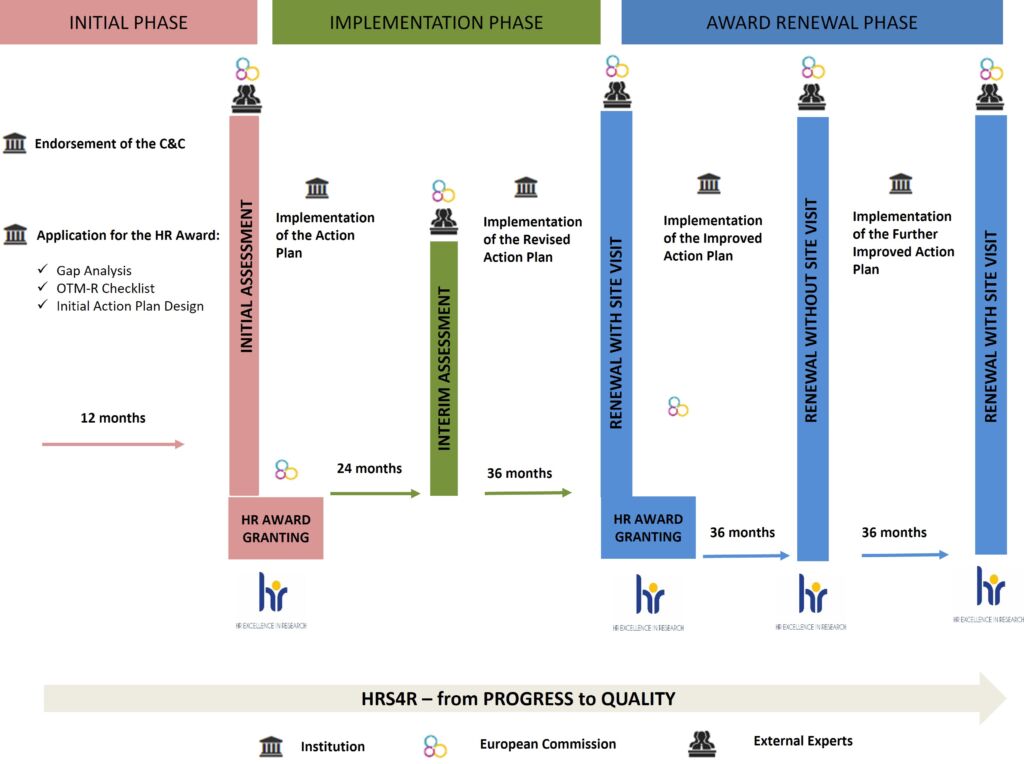
Stages of the process
- The initial phase: this begins with the signing of the letter of commitment and must be carried out within a maximum period of 12 months. This phase involves an internal analysis of the institution's shortcomings and weaknesses in order to assess its practices regarding professional ethics, researcher recruitment, working conditions and training, based on the principles set out in the European Charter for Researchers and the Code of Conduct (GAP Analysis). This analysis makes it possible to establish a series of actions and recommendations to align human resources policies with the stated principles, which are set out in the Action Plan. This initial phase culminates in the award of the HRS4R excellence seal granted by the European Union to institutions that define and implement an action plan to apply the guidelines of the Charter and Code.
- The implementation phase: in this phase, an interim assessment is carried out to check the implementation of the Action Plan by monitoring its progress through the indicators defined for each action and thematic area (ethical and professional aspects, recruitment, working conditions and social security, and training). In addition, this phase defines the procedures leading to an OTM-R Policy (“Open, Transparent and Merit-based Recruitment”).
- The renewal phase: to access this phase, the institution must undergo an on-site assessment by experts who verify in person the degree of implementation of the HRS4R strategy and the institution's commitment to the objectives set during the previous phases. Access to this phase allows the implementation of an improved Action Plan including new activities that enhance the institution's human resources policy relating to research.
This activity is being funded thanks to the earmarked grant from the Regional Ministry of Health of the Community of Madrid to the Foundation for Biomedical Research of the Puerta de Hierro Majadahonda University Hospital, charged to programme 312D «Biomedical Research Foundations» of the Community of Madrid's Expenditure Budget for 2018.

IDIPHISA embraces and supports the European Commission's recommendations contained in the «European Charter for Researchers» and the «Code of Conduct for the Recruitment of Researchers». Likewise, in accordance with its internal policies, it undertakes to develop its human resources strategy by adhering to the recommendations and principles set out in the Charter and the Code, and to ensure transparency, accessibility, fairness and the pursuit of excellence in the recruitment of researchers.
IDIPHISA signed and sent to the European Commission in March 2018 the declaration of commitment to the principles of the “Charter for European Researchers” and the “Code of conduct for the recruitment of researchers”

In April 2019, both the following were sent to the European Commission for assessment: GAP analysis como como el Action Plan carried out by IDIPHISA. IDIPHISA's Action Plan can be downloaded from the following link:
In August 2021, the following was sent to the European Commission for assessment: revised Action Plan within the framework of the interim review after completing the first part of the Implementation Plan:
Specific HR Initiatives at IDIPHISA:
You can check the status of the initiatives planned by IDIPHISA within its HRS4R Action Plan at the following link
Create an Enabling Framework for the Approval of the Collective Bargaining Agreement
This action consisted of creating a favourable framework between the FIB HUPHM and the Community of Madrid so that the Collective Bargaining Agreement could be signed.
2 Update the Procurement Manual and Procedure
- Update the recruitment manual, including all OTM-R and C&C criteria.
- Improve the advertising of job offers: Publish job offers in English on international scientific portals and on Euraxess.
- Formalise the composition of the Selection Committee, increasing its diversity.
- Publish the list of call resolutions together with the score obtained by the candidates who proceed to the interview phase.
The recruitment manual (PNT) has been updated and the CV collection form on the IDIPHISA website has been modified.
3. Define an Evaluation System for Postdoctoral Researchers Employed within the Framework of a Research Project
Define an evaluation system so that postdoctoral researchers, at the end of their contract or annually, can have an official certificate detailing the tasks performed during their contract. The defined evaluation system must be aligned with the guidelines of the research career plan established by the Community of Madrid.
In November 2024, the R2 Researcher Assessment Guide, along with the corresponding evaluation form.
This tool allows R2 researchers to voluntarily request a formal evaluation of their competencies and professional development. The procedure provides a transparent framework to identify strengths, areas for improvement and training needs, supporting the planning of their research career.
The guide includes a description of the different researcher profiles and the competencies associated with the R2 stage, aligned with the European framework for research careers.
4. Strengthen External and Internal Communication Channels
Since 2022, more than have been carried out 50 communication and awareness-raising activities related to the HRS4R strategy and the professional development of researchers.
These activities have included training seminars, information sessions, meetings with researchers, dissemination of new policies and procedures, launch of new web sections, publication of institutional documents, and internal and external communication actions.
Additionally, it was approved Communication Plan 2023-2027 and its corresponding specific annex for HRS4R, with the aim of reinforcing the visibility of initiatives directed at researchers and promoting greater participation of the research community in institutional processes.
5. Improving Access to Training
- The IDIPHISA has a Training Plan 2023-2027 which offers a stable annual training program.
- To identify new training needs, a training needs analysis is carried out every year online survey aimed at the entire research community and support staff, the results of which are used to update the training offer.
- In recent years, IDIPHISA has approved specific budget lines aimed at organising its own courses and strengthening training activities.
- Between 2023 and 2025, courses were taught 172 training courses, covering scientific, transferable, research management and professional development competencies.
6. Establish a Research Career Development Framework
The seminar was organised in 2024 “Development of the research career within the European framework”, delivered by Elisa García García, project manager at the Spanish Foundation for Science and Technology (FECYT). The session provided an opportunity to present the main European models for professional development and the European Commission's recommendations on research careers.
Additionally, in July 2025 the new Collective Agreement for Biomedical Research Foundations of the Community of Madrid, which incorporates a common professional development framework for all FIB personnel.
The agreement establishes a Structured Professional Career Plan in four levels, defining the requirements and competencies associated with each of them and providing a homogeneous framework for career progression and performance recognition.
The progressive implementation of this model constitutes a significant step towards the consolidation of a professional development strategy aligned with the principles of HRS4R.
7. Design a Career Path Map
Design a career pathway map for research inside and outside IDIPHISA. The framework provides information on potential career options and biomedical research funding within the academic and/or industrial sectors, with at least two types of information.
A new section has been created on the IDIPHISA website to provide more information about career development options for researchers:
Career development options for researchers
Additionally, a seminar has been held. The video of the seminar can be accessed via the following
8. Create a Mentor Pilot Programme for ST1 and ST2
In 2025 the first pilot of the IDIPHISA Mentorship Programme aimed at early-career researchers (R1 and R2).
The programme was structured around 6 informal mentor-mentee meetings spread out over a period of approximately 6 months, with the aim of promoting professional development, career planning and the acquisition of transferable skills.
A total of 7 researchers they agreed to take part in this first pilot edition, belonging to different research areas of the Institute:
- 5 researchers in the field of lung cancer.
- 1 Specialty Oncology Trainee.
- 1 researcher from the Cardiology department.
Following the completion of the pilot, a satisfaction survey was carried out, the results of which were used to identify opportunities for improvement and design a second edition of the programme.
As a result of the pilot experience, a new edition of the Mentoring Programme was launched in 2026, consolidating this initiative as a support tool for the professional development of IDIPHISA researchers.
9. Update the Manual of Good Scientific Practice
It must be understood as an instrument of collective self-regulation that reinforces and complements the commitments and recommendations included in the internal regulations.
Additionally, a Research Session on the same topic has been held. The video of this Session can be accessed via the following link:
10. Prepare a Welcome Pack
It will provide new researchers with the information necessary to facilitate their proper and rapid integration into the Institute's working environment.
11. Draw up a Research Infrastructure Inventory
It has been developed and implemented SiGIPHISA, a web application for the registration, management, and consultation of IDIPHISA's scientific infrastructure and equipment.
The platform enables the centralization of information on available equipment and improves its visibility and accessibility for the entire research community.
Among the main features implemented are:
- Bulk upload of equipment using Excel templates.
- Consultation of the scientific equipment available at the Institute.
- Updating and maintenance of information by those responsible for the laboratory.
- Generation of a unique QR code for each registered equipment, facilitating its identification and traceability.
The implementation of this tool helps to optimise the management of research infrastructures, encourage the shared use of equipment and improve access to available scientific resources.
12. Establish the role of the Research Ombudsman
Create the role of the researcher advocate, either through an individual or a committee, to handle complaints and appeals from researchers, including those concerning conflicts between supervisors and early-career researchers.
| Mision | Mediate researchers' appeals at any career stage, with the aim of improving the quality of research across all areas and the working environment. |
| Competences | To act on one's own initiative, or at the request of a party, in relation to complaints, claims, appeals, and irregularities or deficiencies observed concerning respect for rights, duties, and freedoms raised by any member of IDIPHISA. To gather as much information as deemed appropriate from the various bodies and organisations for the fulfilment of its purposes. To attend sessions of IDIPHISA organs that deal with any matter related to or of interest to it. Proposals for resolution and conciliation formulas that facilitate a quick and effective resolution. To issue reports in relation to its actions. Annual activity report |
| Composition | Dr. Carmen de Mendoza, Dr. Silvia Rosado |
| Contact | defensordelinvestigador@idiphim.org |
| IDIPHISA Researcher Defender Bases |  IDIPHISA Researcher Advocate Rules IDIPHISA Researcher Advocate Rules |
13. Promoting Work-Life Balance
Draw up a work-life balance plan with the following objectives:
- Achieving a balance between work and family responsibilities by promoting flexible working arrangements that support work-life balance.
- Adapt the organisation to societal changes related to family, social indicators, habits and customs.
- Protecting maternity and paternity, the care of minor children and dependent persons, by promoting the full integration of men and women with family responsibilities into the organisation.
- Encouraging women's access to and retention in employment.
A Work-Life Balance Plan Annex has been drawn up to provide greater visibility to the actions that had already been approved within IDIPHISA's Equality Plan.
14. Initiation, Awareness-raising and Monitoring of HRS4R
The HRS4R Working Group holds regular meetings to monitor the progress of the various actions included in the Action Plan, analyse the results obtained and propose new initiatives that contribute to compliance with the HRS4R principles.
As part of the awareness-raising and outreach activities, four seminars directed at the research community were organised during 2024:
- Seminar 1: The HRS4R in organisations: Action Plan and OTM-R measures.
- Seminar 2: Good scientific practices within the framework of the HRS4R logo.
- Seminar 3: Development of the research career within the European framework.
- Seminar 4: Recruitment policies and OTM-R implications at IDIPHISA.
Additionally, in 2025 a new survey was conducted aimed at the research community to assess the level of awareness and perception of the measures implemented within the HRS4R Action Plan. The results obtained will be used to guide future actions and define new improvement priorities.
These activities complement the communication, training and participation actions carried out throughout the implementation process of the HR Excellence in Research award.
Access to the sessions:
15. Making Information More Accessible
A new specific website section dedicated to strategy has been developed HRS4R (Human Resources Strategy for Researchers) within the IDIPHISA institutional website, with the aim of improving the accessibility and visibility of all information related to the process.
The section includes information on the different implementation phases of the HR Excellence in Research award, as well as access to the most relevant documentation and resources for the research community.
Among the available content are:
- Description of the HRS4R process and its main milestones.
- Mandatory documentation associated with the implementation and renewal process.
- Monitoring and results of the actions included in the Action Plan.
- HRS4R training and awareness-raising materials.
- Document repository containing the main policies, procedures and guidelines related to the strategy.
In order to facilitate access to information for international researchers, the section also has a full English version.
The aim of this section is to provide IDIPHISA researchers with up-to-date information on the options available for the development of their research careers.
Other relevant documentation