Biobank
Sample Request to the ISCIII Biomodels and Biobanks Platform
BIOBANCO HAS PARTICIPATED IN THE 2025 IBBL BIOSPECIMEN PROFICIENCY TESTING (PT) PROGRAM WITH VERY SATISFACTORY RESULTS –
IBBL Biospecimen Proficiency Testing (PT) programme is endorsed by the International Society for Biological and Environmental Repositories (ISBER).
ACCREDITED IN ACCORDANCE WITH THE UNE-EN ISO 20387 STANDARD
The Biobank of the Puerta de Hierro University Hospital in Majadahonda has obtained accreditation in accordance with the international standard ISO 20387,…
What is a Biobank?
Law 14/2007, of 3 July, on Biomedical Research (Biomedical Research Act 14/2007) and Royal Decree 1716/2011 on Biobanks (Royal Decree 1716/2011 on Biobanks) defines it as a “public or private, non-profit establishment that houses a collection of biological samples conceived for diagnostic or biomedical research purposes and organised as a technical unit with criteria of quality, order and purpose”.
In practice, a Biobank is a research support platform that acts as a link between donors, clinicians and researchers, in order to ensure safe and effective handling of biological samples and their associated data.
Objectives and lines of action
- Acquisition and maintenance of samples available to the scientific community
- Management of biological samples and associated data for biomedical research
- Support and advice, offering a complete range of services to researchers who request it
Vision
The Biobank aims to become a top-quality service for basic, clinical and translational research at national and international level, both for the scientific community and for public and/or private institutions.
Mision
The Biobank's activity must help develop biomedical research under conditions of excellence and quality, generating useful knowledge that can in turn be applied to the treatment of diseases.
Values
The Biobank came about as the result of a collective effort by researchers and physicians who, throughout this hospital's history, have preserved a large number of biological samples from different pathologies obtained through their research and clinical work.
The Biobank now brings together these collections of biological samples in a structure committed to ethics and respect for the donor's individuality, while also being established with a commitment to quality service, transparency, collaboration and openness towards the biomedical scientific community.

Authorisation and registration
The Biobank of Hospital Universitario Puerta de Hierro Majadahonda (HUPHM) / Instituto de Investigación Sanitaria Puerta de Hierro-Segovia de Arana (IDIPHISA) is authorised to operate by the Directorate-General for Regulation and Inspection of the Community of Madrid's Ministry of Health under file number: 9516 CS-00036, and is registered in the National Biobank Network of the Instituto de Salud Carlos III, with the code B0000920
Plataforma ISCIII Biomodelos y Biobanco
The ISCIII Biomodels and Biobanks Platform (PISCIIIBB) is an initiative of the Carlos III Health Institute under the call for ISCIII Platforms to support R&D&I in Biomedicine and Health Sciences within the Strategic Action in Health. The aim of this Platform is to boost the research and innovation capabilities of the National Health System (NHS) and their effective transfer to the productive sector; as support for NHS research, it is made up of various research institutes at a national level.
The Biobank currently belongs to the Biomodels and Biobanks Platform of the Instituto de Salud Carlos III (ISCIII) (http://www.redbiobancos.es) under file number PT23/00015, as an Integrated Biomodels and Biobank Unit of HUPHM/IDIPHISA made up of a multidisciplinary team from three scientific-technological HUBs:
- BIOBANK
- Antonio J. Sánchez López (IDIPHISA). Head of the Unit. Scientific Coordinator
- Silvia Rosado García (IDIPHISA). Technical Coordinator
- María Gil Ligero (IDIPHISA). Laboratory Technician
- Indira García Gómez (IDIPHISA). Laboratory Technician
- ORGANOIDS
- Laura Sanz Alcober (IDIPHISA). Researcher
- Ángel Ayuso Sacido (IIB-UFV). Researcher
- Noemí García Romero (IIB-UFV). Researcher
- Margarita Sánchez-Beato Gómez (IDIPHISA). Researcher
- Felipe Ortega de la O (UCM). Investigador
- ANIMAL MODELS
- Martín Santos González (HUPHM). Researcher
- Jorque Toquero Ramos (HUPHM). Researcher
- David Sánchez Ortiz (HUPHM). Researcher
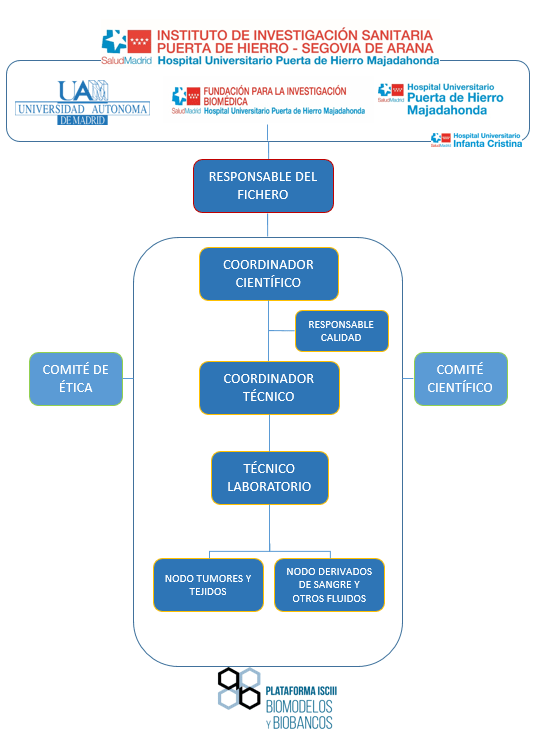
Scientific Coordinator
- Antonio J. Sánchez López
Technical Coordinator
- Silvia Rosado García
Senior Laboratory Technicians
- María Gil Ligero
- Indira García Gómez
- Marta García Suárez
CONTACT
- Email: biobanco@idiphim.org
- Tel: 911916758 – 911917711
LOCATION
- C/ Joaquín Rodrigo, 2. Laboratory Building, 3rd floor
- 28222 Majadahonda – Madrid
The transfer of samples and data is carried out impartially, guaranteeing equal access for the entire scientific community that demonstrates the need for the requested material. Likewise, the requesting entities must make a firm commitment to good scientific and ethical practices, as well as to the strict compliance with the confidentiality obligations applicable to the data and materials provided.
To make a sample request to the Biobank, please follow the procedure detailed below:
1. Get in touch to request information (availability, costs, etc.) and advice:
Joaquín Rodrigo 2 Majadahonda 28222 (Madrid)
(+34) 91 1916758 / 911917711
biobanco@idiphim.org
http://www.investigacionpuertadehierro.com
2. Complete the Sample Transfer Request Form. Send to the Biobank's address signed (digital or scanned signature in pdf or word format) including the requested documentation (project, Principal Investigator's CV and copy of the origin Ethics Committee approval report). Confirmation of receipt of the application will be sent.
3. Assessment of the application by the Biobank's Ethics Committee, Scientific Committee and Scientific/Technical Coordination.
4. The decision shall be communicated to the applicant and, if the transfer is authorised, a Material Transfer Agreement (MTA) between the Biobank and the requesting entity, specifying the commitments that the applicant must accept, as well as shipping and invoicing details.
In parallel, the Sample Transfer Budget will be sent, detailing the cost of the service, which must be completed and accepted.
5. A Transfer Report will be attached together with the samples, describing their characteristics (type, quantity, quality, etc.).
The transfer may be denied for one or more of the following reasons:
– Failure to provide a favourable opinion from the Ethics Committee of the applicant institution
– An unfavourable opinion from the Biobank's Ethics Committee or Scientific Committee
– An unfavourable opinion from the Biobank's Scientific/Technical Management
– The type, volume or quantity of the requested sample would jeopardise the integrity of the collection
– The study for which the samples are requested is considered scientifically redundant
The Biobank recommends that researchers requiring samples for a research project make an availability enquiry prior to submitting the project to the public call for proposals. In response to this enquiry, an Availability Report for the requested samples will be issued. This report shall not be binding, but it will be taken into account by the committees in the event of overlapping interests between multiple applications.
ACCESS TO THE BIOBANK AREA FOR RESEARCHERS AFFILIATED WITH IDIPHISA:
The Biobank offers advice and management in:
- Creation of new collections
- Storage of pre-existing collections under Law 14/2007 on Biomedical Research (LIB)
- Management and control of informed consent
- Training in Biobank management software
The Biobank also offers the possibility of having technical /scientific advice in the creation and maintenance of sample collections, as well as carrying out various histological, molecular and cellular techniques on any samples the researcher wishes to process, even if they do not come from the Biobank.
These fees are indicative; a bespoke quote will be provided based on the request. The acceptance of the services and conditions must be signed by the Principal Investigator and the Biobank Manager. These fees may vary depending on the Biobank's level of involvement in the sample acquisition process (material collection, centrifugations, retrieval of informed consent forms, etc.).
To enquire about this type of service, please contact:
- biobanco@idiphim.org
- 91 191 7711 / 91 191 6758
Scientific Committee
Chair:
- Clara Salas Antón, Pathology-HUPHM
Secretary:
- José Luis Calleja Panero, Gastroenterology-HUPHM
Members:
- Juan Antonio Vargas Núñez, Internal Medicine-HUPHM
- Rafael Duarte Palomino, Haematology-HUPHM
- Cristina Avendaño Solá, Pharmacology-HUPHM
- José Ramón García Berrocal, ENT-HUPHM
- Margarita Sánchez-Beato, Oncology Research-IDIPHISA
- Natalia Gómez, Immunology Research-HUPHM
- Pablo García Pavía, Cardiology-HUPHM
- Isabel Sánchez Romero, Microbiology-HUPHM
Research Ethics Committee for Medicinal Products (CEIm)
Chair:
- Cristina Avendaño Solá, Clinical Pharmacology-HUPHM
Vice-Chair:
- Ana Blasco Lobo, Cardiology-HUPHM
Secretary:
- José Porcel Maleno, Clinical Pharmacology-HUPHM
Members:
- Ana Sánchez Ramos, General and Digestive Surgery-HUPHM
- Antonio Carlos Sánchez Ruiz, Medical Oncology-HUPHM
- Paloma Martin Acosta, Pathology-HUPHM
- Javier Moreno Alemán, Lawyer-External Member
- Purificación Ros Pérez, Paediatrics-HUPHM
- Juan José Granizo Martínez, Head of Clinical Research and Statistics-Hospital Infanta Cristina Parla
- Elena Fuentes Rodríguez, Primary Care Pharmacist
- Pedro Durán Del Campo, Internal Medicine-Healthcare Ethics Committee-HUPHM
- Guillermo Garre Sobrino, Lay Member, representing patients' interests
- Laura Vicente Izquierdo, Nurse-HUPHM
- Sandra de Diego Martín, Social Worker
- Inés Gumiel Baena, Hospital Pharmacy-HUPHM
ACCESS TO THE BIOBANK AREA FOR RESEARCHERS AFFILIATED WITH IDIPHISA:
For its operation, the Biobank has a space divided into:
- Sample Reception Room
- Comprehensive Biobank management software (BioeBank, Vitro)
- Sample Preparation and Processing Room
- BIOIIA laminar flow and biological safety cabinet
- Culture incubator
- Optical microscope
- Refrigerated centrifuges
- Agarose gel electrophoresis system
- Spectrophotometer (NanoDrop, Spectrophotometer, Qubit Fluorimeter 3.0)
- Automatic DNA/RNA extraction system (Promega-MAXWELL 16 Magnetic)
- Haematology counter (MYTHIC18-R)
- Cryopreservation Room I
- Ten -80ºC ultra-low temperature freezers
- One -20ºC freezer
- Two combi fridge-freezers at 4ºC and -20ºC
- Cryopreservation Room II
- One liquid-phase liquid nitrogen tank
Sample Preservation Guarantees
The importance of preserving biological material makes it necessary to use suitable facilities and specific storage equipment that guarantee the proper conservation of the samples.
Access Control
Access to the processing room and Cryopreservation Rooms I and II is controlled by a card-based security restricted to authorised personnel only.
Equipment Monitoring and Alarm System
The cryopreservation rooms and all storage equipment are fitted with sondas PT-100 conectado a softwares (MySirius) de temperature control and temperature alarm management. These systems allow:
- Notifying alarms at three levels: Biobank, Security and Hospital Maintenance (24 hours), who are notified by e-mail and phone calls
- Constant monitoring of the temperature of the ultra-freezers and nitrogen tank
- Obtaining periodic reports on temperatures and alerts
As a contingency measure, there are equipos (BackUp) of similar dimensions and identical characteristics, to which samples can be moved in the event of a breakdown.
The equipment is connected to a SAI (UPS) electrical system (Sistema de Alimentación Ininterrumpida / Uninterruptible Power Supply) which allows power to be supplied by generators in the event of a power failure.

The donation of biological samples to a Biobank constitutes one of the most important acts of disposal through which to contribute to scientific progress in the study of the various diseases or pathologies affecting human beings.
The Biomedical Research Act 14/2007 requires the availability of consent express, written consent from each of the donors of biological samples, so that, prior to such authorisation, each data subject is reliably informed of the reason for the donation and the purpose or line of research to which their biological sample will be allocated.
The destination and conservation of the donated samples will be the Biobank of Hospital Universitario Puerta de Hierro, where, under strict quality and confidentiality criteria, they will be processed and coded, thereby guaranteeing the anonymity of each donor while ensuring that the donated biological material is in optimal quality condition to be allocated to those research projects that the Biobank's oversight bodies (Scientific Committee and Ethics Committee) authorise from a scientific, ethical and legal standpoint.
PRIVACY
In accordance with the provisions of the Organic Law 3/2018 on the Protection of Personal Data and Guarantee of Digital Rights and the General Data Protection Regulation [(EU) 2016/679] you are informed, in accordance with the provisions of Article 13 of the aforementioned European Regulation:
DATA CONTROLLER: Fundación para la Investigación Biomédica del Hospital Universitario Puerta de Hierro de Majadahonda – Calle Joaquín Rodrigo 2, 28222, Majadahonda (Madrid) – 911917645
DATA PROTECTION OFFICER: dpd@idiphim.org
DATA PROTECTION POLICY
Objective
In accordance with the aforementioned data protection regulations, you are informed that the purpose of processing your personal data for Biobank purposes is the management of your personal data for biomedical research purposes within the framework of Hospital Universitario Puerta de Hierro de Majadahonda (National Biobank Registry, No. B.0000920).
Conservation
The conservation of biological samples and their associated data will extend for the period during which sufficient sample exists to be allocated to research projects; consequently, your associated personal information will be retained indefinitely until it is no longer of scientific use, at which point it will be destroyed and/or deleted.
Accordingly, the personal data collected on each donor will be confidential and incorporated into the information processing systems of the Fundación para la Investigación Biomédica del Hospital Puerta de Hierro de Majadahonda, all in accordance with the provisions of this data protection regulation, applicable health legislation and current regulations relating to biomedical research, and processed solely in accordance with the purposes described above.
Results
The results obtained from the different studies carried out with each biological sample may be published in scientific journals, however, the identity of donors or data will never be disclosed that identify them or could identify them.
Confidentiality
Any link between your sample and your personal identity is strictly confidential. Once you consent to the use of your sample for the research purposes described, said surplus will undergo a process of dissociation or coding. In other words, it will only be identified by a number and/or a code, with all of its data duly coded, so that the researchers involved will never know your identity or any data that could identify you; however, they may still access other data such as your sex or age, always maintaining due confidentiality in accordance with current legislation.
Rights
In accordance with the aforementioned data protection legislation, your identifying personal information will not be disclosed to any recipient except in cases where the law expressly permits it or requires it of us in order to comply with a legal obligation; outside of these cases, the Foundation would request your express consent. Likewise, the Foundation will not use your personal information for any purpose other than that stated here or incompatible with it. The legal basis for the processing of your personal data described here is your own consent. You may exercise your rights of access, rectification, erasure, restriction of processing, portability and objection at the following address:
Att. BIOBANK, C/Joaquín Rodrigo, 2 – 28222 Majadahonda – Madrid, directing your request to the attention of Data Protection Officer, or by e-mail: dpd@idiphim.org
He or she will also be able to withdraw the consent initially given that may have been issued for the donation of biological material, with no need to give any explanation for the decision taken. However, you should be aware that the consequences of the revocation will not affect data resulting from projects to which your donated biological material has already been allocated. In the initial consent form you sign authorising the donation, you may also include any usage restriction you consider appropriate.
Right to lodge a complaint
Likewise, in compliance with the provisions of the GDPR, you are informed that, should you wish, you may contact the Spanish Data Protection Agency (http://www.agpd.es/portalwebAGPD/index-ides-idphp.phpto obtain additional information regarding your rights and/or to file a complaint if they have not been duly addressed.
More information
If you need to know additional information on the processing of your personal data, you can find this additional information at the following link on our website: Privacy Policy and Data Protection