

The Puerta de Hierro Majadahonda University Hospital participates in the annual meeting of the European consortium UNCAN-Connect
Scientific Culture and Innovation Unit
The European consortium UNCAN-Connect has held its first annual meeting in Barcelona, a meeting that strengthens international collaboration to promote research and innovation in cancer through the access and exchange of oncology data from different countries. The Puerta de Hierro University Hospital, a clinical partner of the project, participated in this meeting, with the representation of Dr. María Torrente, coordinator of the project.
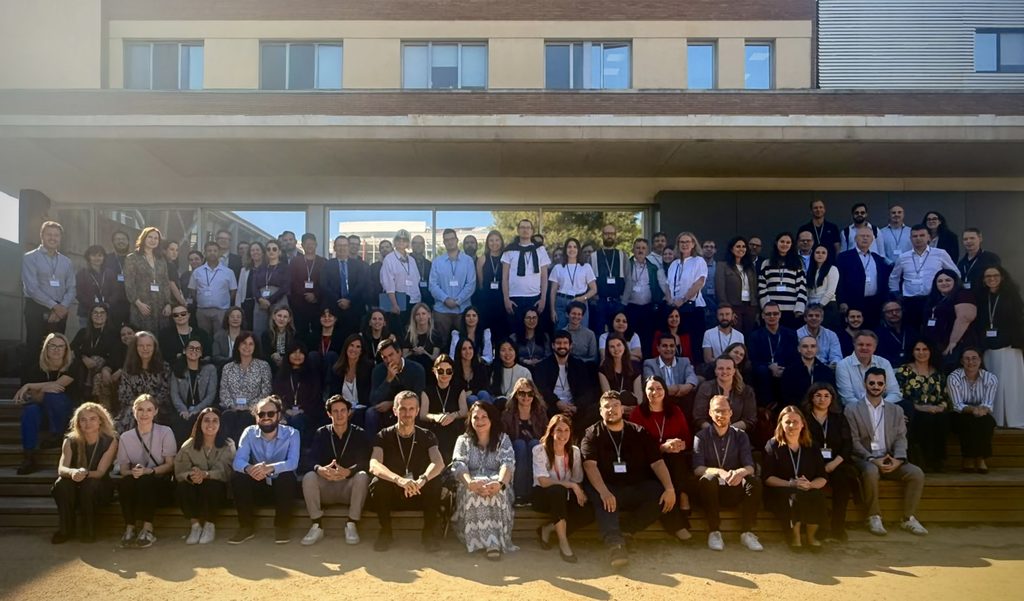
On October 28 and 29, the European consortium UNCAN-Connect held its annual meeting in Barcelona, organized by the Fundació Sant Joan de Déu (FSJD-HSJD), with about 120 participants. The meeting marks the first year of work of the project, which began in Tallinn in October 2025, and was attended by the Puerta de Hierro Majadahonda University Hospital, represented by Dr. María Torrente.
The initiative UNCAN-Connect, Funded by Horizon Europe as part of the Cancer Mission, it brings together hospitals, research infrastructures, technology centers, and patient organizations from across Europe to address the main challenges in current research: harnessing the vast volume of clinical data available and facilitating its access and secure exchange between institutions and countries. Furthermore, cancer is the second leading cause of death on the European continent and, as the project itself mentions, if measures are not taken, these cases could increase by more than 24% by 2035.
Its goal is to develop UNCAN.eu, a federated platform that allows the promotion of oncological research through the access and analysis of data from different countries, without the need to transfer them outside the centers where they are generated. In other words, it proposes to form a collaborative network that effectively uses the cancer data that exist in hospitals or in cancer registries across the EU, allowing for safe and ethical access, while respecting the rights of patients. In addition, the project is organized around six use cases focused on different types of cancer, including pediatric cancer, lymphoma, pancreatic cancer, ovarian cancer, lung cancer, and prostate cancer.
During the Barcelona meeting, the teams reviewed the progress achieved during the first year, adjusted the planning of activities for the second year, and strengthened collaboration between the clinical, technical, and governance areas, thus consolidating joint work to advance towards more connected and innovative oncology research at the European level.
Coordinators in the European network
The Puerta de Hierro Majadahonda University Hospital is the only Spanish center in the project that performs functions of coordination at the European level. Specifically, it is responsible for coordinating the lung cancer and lymphoma working groups, as well as addressing the participation of the Spanish hospitals and entities that are part of the consortium.
In these two groups, work will be carried out on aspects such as early detection of the disease, the follow-up of treatments, and improving the quality of life of patients. To achieve this, an integrated and multidisciplinary approach is proposed that includes the control of symptoms, cardiovascular risk factors, and the incorporation of physical exercise guidelines.
Experience in European projects: from data to impact in clinical practice
Oncology research has experienced significant advances in recent decades, both in the early detection and treatment of the disease. These advancements are complemented by the potential of tools such as artificial intelligence (AI), which allow for the analysis of large volumes of clinical information and the identification of patterns that can help predict the evolution of the disease, detect patients at higher risk of relapse, and move towards more personalized care.
In this context, the Puerta de Hierro Hospital has led other European projects on cancer research, such as CLARIFY or SHARE.
The CLARIFY initiative – Artificial Intelligence Follow-up for Long-Surviving Cancer Patients It is a program funded by the European Commission under the Horizon 2020 program with 4.8 million euros and aims to track the long-term survival of cancer patients through big data and artificial intelligence.
To achieve this, a tool was developed that can integrate different types of data, such as clinical and genomic information, quality of life questionnaires and scientific publications, with the aim of identifying patterns that help better understand the evolution of the disease, identify the clinical factors associated with poor prognosis, relapse and survival, and develop a model that allows classifying patients according to their risk and guiding medical decision-making.
The study included information from 5,275 patients diagnosed with non-microscopic lung cancer, breast cancer and non-Hodgkin lymphoma who were treated at the hospital. The analysis combined clinical data with information from questionnaires and portable devices, allowing the study to examine the evolution of the patients, calculate survival probabilities and identify different risk profiles.
Another of the projects led by the hospital center is the SHARE project – (SpanisH cAnceR data spacE), a pioneering initiative funded by the NExtGenerationUE funds, which has enabled the creation of a national data space and collaboration between 197 Spanish hospitals to boost research and improve care for patients with lung cancer. The initiative includes clinical information from more than 30,000 patients, and could help track the disease, identify patients at higher risk of relapse, anticipate the response to a given treatment, or study factors such as age, sex, or social and geographic characteristics of the patients.
Towards more personalized medicine
The participation of the Hospital Puerta de Hierro in UNCAN-Connect represents another step in its commitment to research excellence based on data analysis, collaboration between centers, and more personalized care.
References:
Torrente M, Sousa PA, Hernández R, Blanco M, Calvo V, Collazo A, Guerreiro GR, Núñez B, Pimentao J, Sánchez JC, Campos M, Costabello L, Novacek V, Menasalvas E, Vidal ME, Provencio M. An Artificial Intelligence-Based Tool for Data Analysis and Prognosis in Cancer Patients: Results from the Clarify Study. Cancers (Basel). 2022 Aug 22;14(16):4041. doi: 10.3390/cancers14164041. PMID: 36011034; PMCID: PMC9406336.